







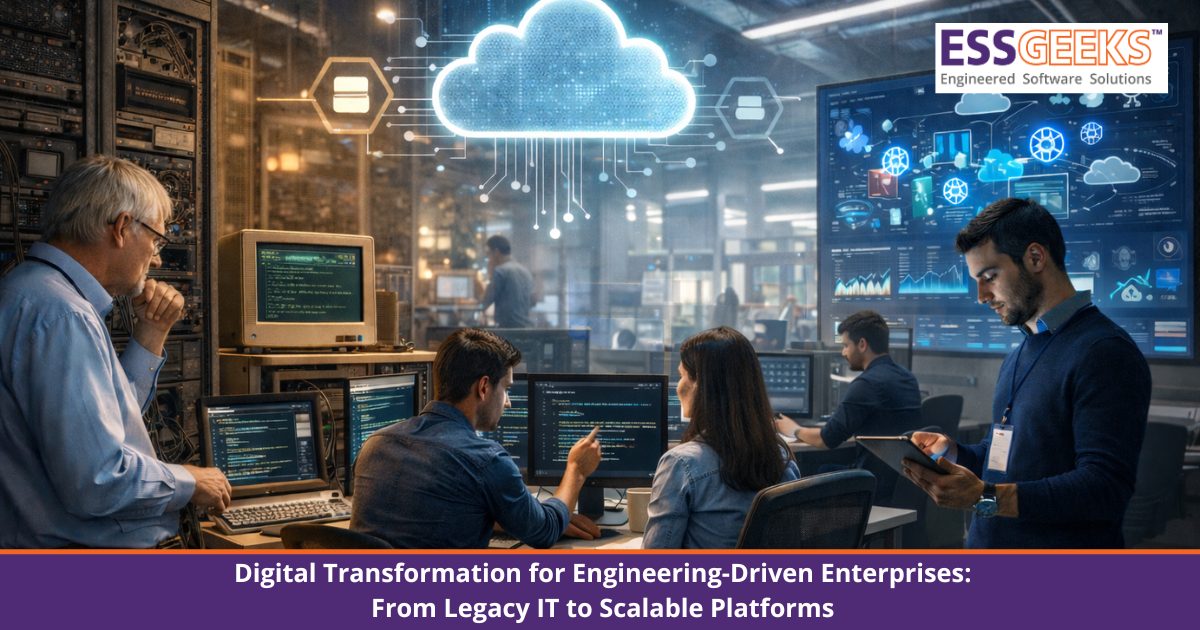
Digital Transformation for Engineering-Driven Enterprises: From Legacy IT to Scalable Platforms
Digital transformation has become a board-level priority across industries. Yet for engineering-driven enterprises, manufacturers, OEMs, EPCs, and industrial technology providers, digital initiatives often stall, overrun budgets, or fail to deliver meaningful impact.
The reason is not lack of investment or intent. It is a fundamental mismatch between generic IT-led transformation models and the realities of engineering environments. Engineering organizations operate on complex data structures, long product lifecycles, strict compliance requirements, and deeply embedded legacy systems. Treating these environments like standard enterprise IT landscapes leads to fragmented platforms, frustrated teams, and expensive rework.
This article explores why digital transformation in engineering organizations is different, why many initiatives fail, and how an engineer-first, platform-based approach enables scalable, future-ready transformation without disrupting ongoing operations.
Why Engineering Organizations Struggle with Digital Transformation
Across global engineering enterprises, the symptoms are familiar:
- Multiple disconnected systems for engineering, manufacturing, service, and sales
- Heavy reliance on spreadsheets, emails, and manual handoffs
- Poor visibility into project status, revisions, and approvals
- Slow response to design changes and customer requirements
Many digital initiatives attempt to solve these issues by implementing new tools like ERP upgrades, PLM replacements, cloud platforms, or collaboration software. Yet the underlying problems persist.
The core issue is that engineering work is workflow-driven, not tool-driven.
When transformation efforts focus on deploying software rather than understanding how engineers design, validate, release, and support products, technology becomes an additional layer of complexity instead of a solution.
What Makes Engineering-Driven Enterprises Fundamentally Different
Engineering-centric organizations differ significantly from pure IT or service enterprises in four critical ways.
1. Engineering Data Is Complex and Interdependent
Engineering data includes CAD models, drawings, BOMs, specifications, simulations, test results, and revision histories. These assets are tightly linked and evolve continuously across the product lifecycle.
A minor change in design can cascade across manufacturing, procurement, quality, and service. Systems must preserve context, relationships, and traceability, not just store files.
2. Long Product Lifecycles and Compliance Constraints
Engineering products often remain in service for decades. Systems must support:
- Long-term data retention
- Regulatory compliance
- Auditability and revision traceability
Quick software replacements or frequent platform changes are rarely feasible.
3. Multi-Plant, Multi-Geography Collaboration
Engineering work spans regions, time zones, and partners. Coordination challenges multiply when teams rely on local tools, informal processes, or undocumented workflows.
4. Deep Dependency on Legacy Systems
Legacy engineering tools often encode years of domain knowledge. While outdated, they continue to support mission-critical operations. Replacing them outright introduces unacceptable risk.
These realities demand a very different transformation strategy from traditional IT modernization.
The Reality of Legacy IT in Engineering Organizations
Most engineering enterprises operate with a layered mix of systems:
- ERP for transactions
- PLM for product data
- MES for manufacturing execution
- Custom tools, spreadsheets, and local databases
While each system serves a purpose, they rarely communicate seamlessly. Engineers are forced to bridge gaps manually copying data, reconciling versions, and validating information repeatedly.
This fragmentation leads to:
- Design inconsistencies
- Delayed approvals
- Increased rework
- Loss of engineering productivity
Attempts to “rip and replace” these systems often fail due to cost, disruption, and resistance from users who depend on existing workflows.
The challenge is not eliminating legacy systems but making them work together intelligently.
Engineer-Led vs IT-Led Digital Transformation
A key differentiator between successful and failed initiatives lies in who leads the transformation.
IT-Led Transformation
- Focuses on infrastructure, licenses, and standardization
- Prioritizes deployment speed over usability
- Assumes users will adapt to tools
This approach often results in systems that are technically sound but operationally misaligned.
Engineer-Led Transformation
- Starts with engineering workflows and decision points
- Designs systems around how work actually happens
- Integrates technology into existing processes gradually
By grounding design decisions in engineering realities, organizations reduce rework, accelerate adoption, and achieve measurable ROI.
Engineer-led transformation does not reject IT principles it applies them with engineering context.
Core Pillars of Scalable Engineering Digital Platforms
Successful digital transformation in engineering environments rests on a few foundational principles.
1. Workflow-Centric Design
Rather than forcing engineers to adapt to software, platforms must adapt to engineering workflows:
- Design reviews
- Change approvals
- Release management
- Collaboration across disciplines
Automating these workflows improves consistency without removing flexibility.
2. Modular, API-Driven Architecture
Scalable platforms allow legacy systems to coexist with modern applications. APIs enable:
- Gradual modernization
- Reduced integration risk
- Future extensibility
This approach avoids the all-or-nothing trap of large replacements.
3. Single Source of Truth
Engineering platforms must maintain data integrity across departments. A unified data backbone ensures:
- Consistent revisions
- Accurate downstream execution
- Reliable audit trails
Without a single source of truth, digital tools amplify confusion rather than eliminate it.
The Role of Custom Software in Engineering Transformation
Off-the-shelf software plays an important role, but it rarely addresses the full complexity of engineering operations.
Custom software bridges the gap between standardized platforms and unique engineering workflows by:
- Encapsulating proprietary processes
- Integrating diverse systems
- Providing intuitive interfaces for engineers
When designed correctly, custom solutions do not increase maintenance burden, they reduce operational friction.
This is where engineering-focused digital partners like ESSGEEKS differentiate themselves: by combining software engineering with deep understanding of industrial workflows.
Security, Compliance, and Reliability Considerations
Engineering data represents core intellectual property. Digital platforms must address:
- Role-based access control
- Secure data exchange
- Compliance with export, quality, and regulatory standards
Reliability is equally critical. Engineering systems cannot afford downtime or data inconsistencies. Transformation efforts must prioritize stability alongside innovation.
A Practical Roadmap for Engineering Digital Transformation
Effective transformation follows a phased, risk-aware approach.
Phase 1: Discovery and Workflow Mapping
- Identify critical engineering processes
- Map data flows and dependencies
- Define success metrics
Phase 2: Coexistence with Legacy Systems
- Introduce integration layers
- Improve visibility without disruption
Phase 3: Incremental Modernization
- Replace manual steps with controlled workflows
- Introduce automation gradually
Phase 4: Scale and Optimize
- Extend platforms across plants and regions
- Use analytics to drive continuous improvement
This roadmap prioritizes business continuity and adoption, not just technology upgrades.
Business Impact of Engineer-First Digital Transformation
When executed correctly, organizations experience tangible benefits:
- Reduced engineering rework
- Faster design cycles
- Improved collaboration across teams
- Lower total cost of ownership
More importantly, digital platforms become strategic assets, enabling innovation rather than constraining it
Conclusion
For engineering-driven enterprises, digital transformation is not an IT project it is an evolution of how engineering work is performed, governed, and scaled.
Success depends on:
- Respecting engineering realities
- Preserving institutional knowledge
- Designing platforms that grow with the organization
Enterprises that adopt an engineer-first approach build systems that support today’s operations while preparing for tomorrow’s challenges.
The question is no longer whether to transform, but how intelligently and sustainably it can be done.
Talk to us today! Reach us on sales@essgeeks.com