








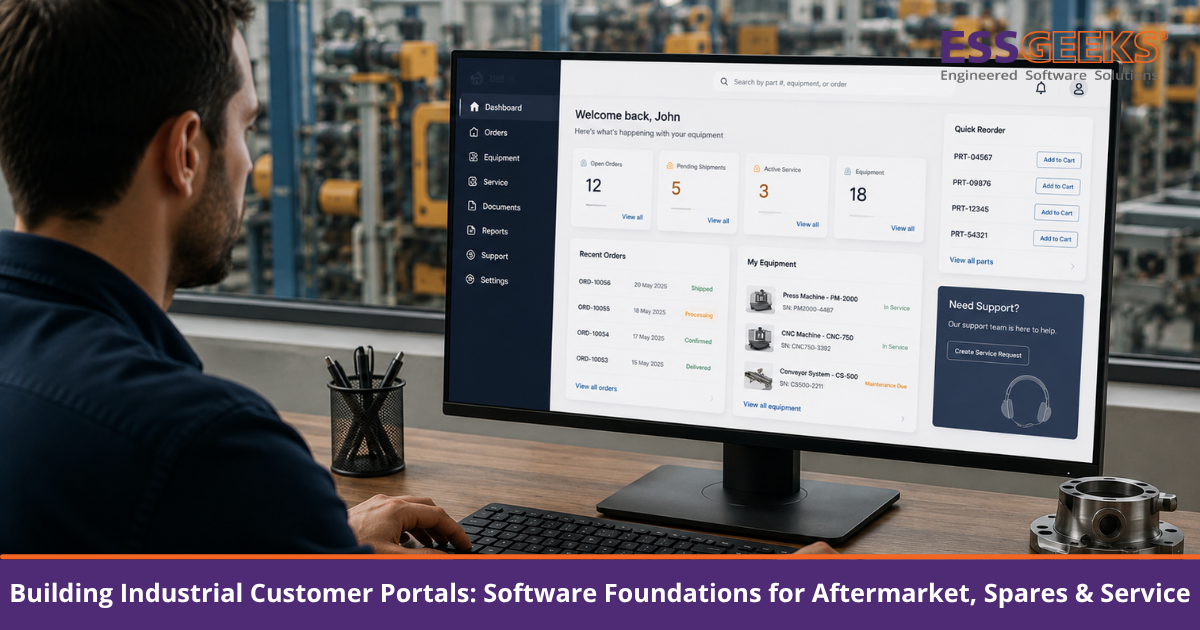
Building Industrial Customer Portals: Software Foundations for Aftermarket, Spares & Service
Across global manufacturing markets OEMs are undergoing a structural shift. The traditional model of selling capital equipment with limited post-sale engagement is no longer sustainable. Margins are tightening, competition is intensifying, and customers expect always-on digital access.
Today, aftermarket, spares, and service operations are becoming the primary drivers of profitability and customer retention.
Industrial buyers now expect:
- 24/7 spare parts ordering
- Real-time service tracking
- Instant access to documentation
- Transparent warranty visibility
- Predictive maintenance alerts
However, most heavy engineering companies still operate with fragmented systems, ERP in one place, PLM in another, field service tools disconnected, and customer communication handled manually.
This is where industrial customer portals become transformational.
A well-architected industrial portal is not a basic login dashboard. It is a strategic digital platform that connects ERP, PLM, field service systems, and IoT data into a unified customer experience, unlocking new revenue, reducing operational friction, and strengthening long-term relationships.
What Is an Industrial Customer Portal?
An industrial customer portal is a secure, integrated, role-based digital platform that enables OEM customers, and service partners to interact with equipment, spare parts, service workflows, and documentation in real time.
Unlike generic B2B portals, industrial platforms must handle:
- Engineering revisions and version history
- Serial number-based asset tracking
- Global pricing hierarchies
- Compliance documentation
- Service-level agreements (SLAs)
For heavy engineering and manufacturing organizations, the portal becomes the digital extension of the product lifecycle.
Why Aftermarket & Service Portals Matter for Global OEMs
For decision-makers such as CIOs, Heads of Digital Transformation, Aftermarket Directors, and ERP Managers, the business case is clear.
- Revenue Growth:
Aftermarket services often generate higher margins than original equipment sales. A digital portal enables:
– Faster spare parts ordering
– Intelligent cross-sell recommendations
– Automated consumables reordering
– Upgrade package promotionsOrganizations implementing structured portals frequently observe measurable increases in spare parts revenue and service contract renewals.
- Operational Efficiency:
Manual spare parts lookup, email-based service requests, and disconnected systems increase administrative overhead. Portals reduce:
– Manual order entry
– Duplicate data handling
– Delayed response times
– Internal coordination bottlenecks - Customer Retention:
Industrial buyers value reliability and responsiveness. A centralized platform enhances transparency, trust, and brand credibility.
Core Software Architecture Foundations
Building a high-performance industrial portal requires a strong technical foundation. The architecture must support scalability, integration complexity, and global operations.
1. Modular, API-First Architecture
Modern portals should adopt API-first design principles. This ensures seamless integration with:
- ERP systems
- PLM platforms
- Field service management tools
- CRM systems
- IoT monitoring platforms
A modular architecture enables OEMs to expand functionality over time without rebuilding the system.
2. Multi-Tenant & Role-Based Access
Industrial ecosystems are layered. A single OEM may operate across:
- End customers
- Service partners
- Internal subsidiaries
Each stakeholder requires different visibility and access levels. Role-based access control (RBAC) ensures secure data segregation while maintaining usability.
3. Cloud-Ready, Hybrid-Compatible Infrastructure
For global deployments, architecture must support:
- Multi-region hosting
- Data residency compliance
- High availability
- Disaster recovery planning
Hybrid approaches are often required for organizations operating legacy on-premises ERP environments.
Essential Functional Modules of an Industrial Portal
A successful platform integrates multiple functional pillars.
1. Intelligent Spare Parts Commerce Engine
Industrial spare parts management is complex. The portal must provide:
- Exploded BOM visualization
- Serial number-based part mapping
- Engineering revision tracking
- Substitute part suggestions
- Dynamic region-based pricing
When spare parts identification becomes intuitive, customers place orders faster and with fewer errors.
2. Service & Maintenance Management
An effective service module should enable:
- Ticket creation and tracking
- SLA visibility
- Technician scheduling integration
- Preventive maintenance reminders
- Escalation workflows
This improves first-time fix rates and reduces downtime.
3. Equipment Digital Passport
Each machine should have a digital record containing:
- Installation date
- Service history
- Warranty status
- Compliance certificates
- Performance logs
This centralized asset history enhances lifecycle management and supports predictive maintenance initiatives.
4. Technical Documentation & Knowledge Hub
Industrial customers require access to:
- Operation manuals
- Engineering drawings
- Safety guidelines
- Compliance certificates
- Training videos
Advanced portals may integrate interactive 3D models, enabling users to explore assemblies and identify parts visually.
Data Integration: The Backbone of Portal Success
Portals fail when they operate in isolation. Integration determines success.
ERP Integration
ERP systems manage:
- Order processing
- Inventory
- Pricing
- Financial transactions
The portal must sync real-time inventory and pricing to avoid order mismatches.
PDM / PLM Integration
PDM / PLM platforms manage:
- Engineering revisions
- BOM structures
- Product configuration
Without PDM / PLM integration, spare parts lookup becomes inaccurate particularly in heavy engineering sectors with frequent design updates.
Field Service Integration
Field service tools provide:
- Service completion reports
Connecting these systems ensures customers can track previous service history transparently.
IoT & Predictive Maintenance Integration
Advanced portals integrate machine telemetry to:
- Trigger maintenance alerts
- Predict part failures
- Schedule proactive service
This shifts OEMs from reactive service models to predictive lifecycle partners.
Security & Compliance in Industrial Portals
Industrial customer portals contain sensitive data:
- Engineering specifications
- Pricing structures
- Equipment performance metrics
Security architecture must include:
- Multi-factor authentication
- Zero trust access models
- Data encryption at rest and in transit
- Secure API gateways
- Continuous monitoring and audit logs
For global OEMs operating in Europe, compliance with GDPR is essential. For organizations in India or the GCC, data localization regulations may apply. A compliant design strengthens credibility and protects enterprise assets.
Business Impact: Quantifiable ROI
When implemented strategically, industrial portals deliver measurable returns.
Revenue Impact
- Increased spare parts conversion rates
- Higher service contract renewals
- Upselling of modernization packages
Cost Reduction
- Lower manual processing costs
- Reduced call centre dependency
- Fewer order errors
Operational Improvements
- Faster service response time
- Improved technician productivity
- Better inventory planning
Customer Experience Gains
- 24/7 access
- Transparent communication
- Faster dispute resolution
For global enterprises, these improvements directly influence competitiveness in mature markets and high-growth regions.
Implementation Roadmap for Industrial Enterprises
A structured rollout ensures long-term success.
Phase 1: Discovery & Strategy
- Stakeholder interviews
- Current system mapping
- Pain-point identification
- Revenue opportunity assessment
Phase 2: Data Architecture & Integration Planning
- ERP mapping
- PDM / PLM alignment
- Middleware selection
- API framework design
Phase 3: UX & Workflow Design
- Persona-based interface design
- SLA and escalation mapping
Phase 4: Development & Testing
- Modular build
- Security testing
- Integration validation
- Performance benchmarking
Phase 5: Deployment & Change Management
- Pilot rollout
- User training
- Feedback cycles
- Continuous improvement roadmap
Adoption planning is as important as technical execution. Without internal alignment, even well-built platforms underperform.
Custom vs Off-the-Shelf: Strategic Considerations
Many industrial enterprises initially explore SaaS portal solutions. While these may work for simple environments, heavy engineering ecosystems often demand:
- Deep ERP customization
- Complex BOM handling
- Multi-region pricing rules
- Engineering revision tracking
In such cases, custom enterprise platforms provide greater flexibility, integration depth, and long-term scalability.
For CIOs and Digital Transformation leaders, the portal should be viewed not as software expenditure but as a strategic infrastructure investment.
Global Deployment Considerations
OEMs operating across India, APAC, EMEA, the US, and the UK must plan for:
- Multi-currency support
- Multi-language interfaces
- Regional compliance regulations
- Time-zone-based service coordination
- Cloud region redundancy
A globally scalable architecture ensures future expansion does not require re-engineering.
Future Outlook: Portals as Digital Ecosystems
Industrial portals are evolving beyond transactional tools. Future-ready platforms may include:
- AI-driven spare parts recommendations
- Chatbot-based service support
- Digital twin visualization
- Augmented reality troubleshooting guides
- Subscription-based service dashboards
The convergence of enterprise software, IoT, and intelligent automation is redefining how OEMs engage customers.
Conclusion
Industrial customer portals are no longer optional enhancements. They are foundational infrastructure for modern manufacturing enterprises.
For OEMs and heavy engineering organizations seeking:
- Sustainable aftermarket revenue
- Operational efficiency
- Stronger global customer engagement
- Competitive differentiation
A secure, integrated, scalable industrial portal provides the digital backbone.
The organizations that treat aftermarket, spares, and service as digitally connected ecosystems rather than disconnected departments, will lead the next decade of industrial growth.
Talk to us today! Reach us on sales@essgeeks.com
Frequently Asked Questions
What is an industrial customer portal?
A secure, integrated platform that allows OEM customers to manage spare parts, service requests, documentation, and equipment lifecycle information in real time.
Why do OEMs need ERP integration in portals?
To synchronize inventory, pricing, order status, and financial data accurately across systems.
Is custom software better than SaaS for heavy engineering?
For complex manufacturing ecosystems with multi-level BOMs, custom platforms often provide greater flexibility and scalability.