






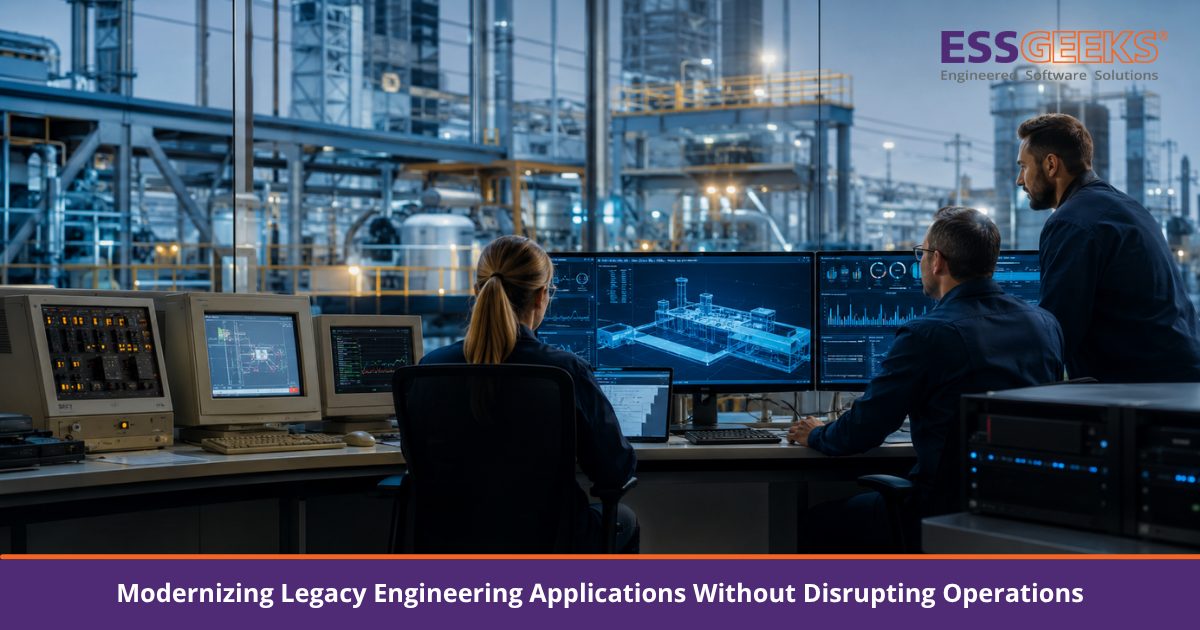
Modernizing Legacy Engineering Applications Without Disrupting Operations
Legacy engineering applications are often described as outdated, inefficient, or inflexible. Yet despite years of digital transformation initiatives, many engineering-driven enterprises continue to rely on systems-built decades ago, sometimes on unsupported technologies, sometimes maintained by only a handful of people.
This persistence is not due to resistance to change or lack of innovation. It is because legacy engineering systems still perform mission-critical functions and replacing them carries real operational risk.
For manufacturers, OEMs, EPCs, and industrial technology providers, the challenge is not whether to modernize, but how to modernize without disrupting ongoing engineering work, production schedules, and project commitments.
Let’s explore why legacy engineering systems endure, why “rip-and-replace” modernization strategies often fail, and how organizations can modernize incrementally preserving continuity while building future-ready platforms.
Why Legacy Engineering Applications Still Exist
Legacy systems rarely survive by accident. In engineering organizations, they often exist for very specific and valid reasons.
- They Encode Decades of Engineering Knowledge
Many legacy applications reflect years of refinement:
- Custom calculations
- Embedded design rules
- Workflow logic aligned with internal processes
This knowledge is rarely documented elsewhere. Replacing the system risks losing institutional memory that engineers depend on daily.
- They Are Deeply Embedded in Workflows
Legacy systems often sit at the center of engineering operations, connected formally or informally to CAD tools, spreadsheets, approval processes, and manufacturing handoffs. Even if the technology is outdated, the workflow dependency is strong.
- They “Still Work” Operationally
From an engineering perspective, a system that produces accurate outputs and supports daily work is considered reliable even if it lacks modern interfaces or scalability. The risk of downtime outweighs the discomfort of inefficiency.The Fear That Slows Modernization
Engineering organizations are cautious by necessity. The fear surrounding legacy modernization is not irrational.
Common concerns include:
- Production or project downtime
- Loss of data integrity
- Disruption to validated engineering processes
- User resistance and retraining costs
When modernization is framed as a replacement event rather than a transition, these concerns intensify often halting progress entirely.
Why “Rip-and-Replace” Strategies Fail in Engineering Environments
Traditional modernization approaches often assume that legacy systems can be replaced in a single, decisive move. In engineering contexts, this approach creates more problems than it solves.
- Complexity Is Underestimated
Legacy engineering systems are rarely standalone. They are surrounded by:
- Custom scripts
- Manual workarounds
- Informal dependencies
Replacing the visible system does not eliminate these hidden connections, it exposes them.
- Engineering Validation Is Overlooked
Engineering outputs must be validated against real-world constraints. New systems require extensive testing across multiple scenarios, which is often underestimated in project planning.
- User Adoption Is Forced, Not Earned
When systems are replaced abruptly, engineers are expected to adapt quickly. This often leads to parallel use of old tools, reintroducing inefficiencies the modernization aimed to eliminate.
- Costs Escalate Late
Initial replacement costs may appear manageable, but integration issues, rework, and operational delays cause budgets to balloon late in the project, when rollback is no longer feasible.
A Shift in Perspective: Modernization as Coexistence
Successful modernization efforts treat legacy systems not as obstacles to remove, but as assets to integrate and evolve. The goal is not immediate replacement, but progressive value creation.
This mindset shift enables organizations to:
- Reduce risk
- Maintain continuity
- Deliver incremental benefits early
Modernization becomes a journey, not a single event.
The Incremental Modernization Strategy
An incremental approach allows engineering organizations to modernize without disrupting daily operations.
- System Mapping and Dependency Analysis
Before writing a line of new code, organizations must understand:
- What the legacy system does
- Who uses it
- What inputs it consumes
- What outputs it produces
Equally important is identifying informal dependencies, spreadsheets, scripts, and manual processes that rely on legacy data. This discovery phase often reveals that modernization challenges are more about workflows than technology.
- API and Integration Layers
Rather than replacing legacy systems, organizations can:
- Expose critical functions through APIs
- Create controlled data exchange points
- Enable modern applications to coexist
This approach preserves the core logic while allowing new capabilities, dashboards, web interfaces, and analytics to be layered on top. The legacy system continues to function, but its value increases.
- Parallel System Operation
In high-risk environments, new systems should operate in parallel with legacy applications:
- Engineers can validate outputs side-by-side
- Discrepancies are identified early
- Confidence builds gradually
Parallel operation reduces resistance and ensures that modernization does not compromise engineering accuracy.
- Gradual Feature Migration
Not all features need to move at once. Organizations can prioritize:
- High-friction workflows
- Manual processes prone to error
- Areas with the greatest performance bottlenecks
By migrating features incrementally, teams see tangible benefits early building momentum and buy-in.
Maintaining Engineering Continuity During Transition
Modernization success depends on preserving continuity not just technically, but culturally.
- Version Control and Traceability
During coexistence, systems must maintain clear ownership of data:
- Which system is authoritative?
- How are changes synchronized?
Without this clarity, confusion undermines trust.
- User-Centered Adoption
Engineers adopt systems when they:
- Reduce effort
- Improve clarity
- Respect established workflows
Training alone cannot overcome poorly aligned design.
- Data Integrity Above All
Engineering decisions depend on data accuracy. Modernization efforts must prioritize validation, auditability, and rollback capabilities.
Real-World Modernization Scenarios
Incremental modernization can take many forms, depending on organizational needs.
- Legacy PLM with a Modern Web Interface
Instead of replacing PLM logic, organizations build modern interfaces that improve usability, accessibility, and collaboration without touching validated core processes.
- Replacing Spreadsheet-Driven Workflows
Manual spreadsheets are replaced with controlled, workflow-driven systems that retain flexibility while adding traceability and validation.
- Engineering Dashboards Layered on Existing Systems
Modern analytics and visualization tools are integrated to provide real-time insights, without altering transactional systems.
These approaches deliver immediate value while preserving operational stability.
The Role of Engineering-Focused Digital Partners
Incremental modernization requires partners who understand both engineering and software, not one or the other.
Engineering-focused teams like ESSGEEKS bring value by:
- Translating engineering workflows into scalable architectures
- Designing coexistence strategies instead of replacements
- Reducing risk through phased delivery
This hybrid understanding is critical when modernization affects core engineering operations.
Business Benefits of Non-Disruptive Modernization
Organizations that modernize incrementally achieve benefits that extend beyond technology.
- Reduced Operational Risk
Core systems remain stable while new capabilities are introduced gradually.
- Faster ROI
Early wins such as improved visibility or reduced manual work deliver value before full modernization is complete.
- Higher User Adoption
Engineers trust systems that evolve with their workflows, not against them.
- Future-Ready Architecture
API-driven platforms prepare organizations for analytics, automation, and advanced digital initiatives without repeated rework.
Common Signs Your Organization Is Ready for Incremental Modernization
- Legacy systems are stable but inflexible
- Engineers rely on manual workarounds
- Replacement discussions stall due to risk concerns
- Digital initiatives struggle to gain adoption
These signals indicate that modernization is needed, but replacement is not the answer.
Conclusion
For engineering-driven enterprises, legacy systems are not merely technical debt, they are operational assets with embedded knowledge and trust.The challenge is not to eliminate them, but to evolve them intelligently.
Incremental modernization enables organizations to:
- Preserve engineering continuity
- Reduce transformation risk
- Build scalable digital platforms over time
In an environment where downtime and errors carry significant cost, the ability to modernize without disruption is not just prudent, it is a competitive advantage.
Digital transformation succeeds when it respects engineering realities, prioritizes continuity, and delivers value step by step.
Talk to us today! Reach us on sales@essgeeks.com